












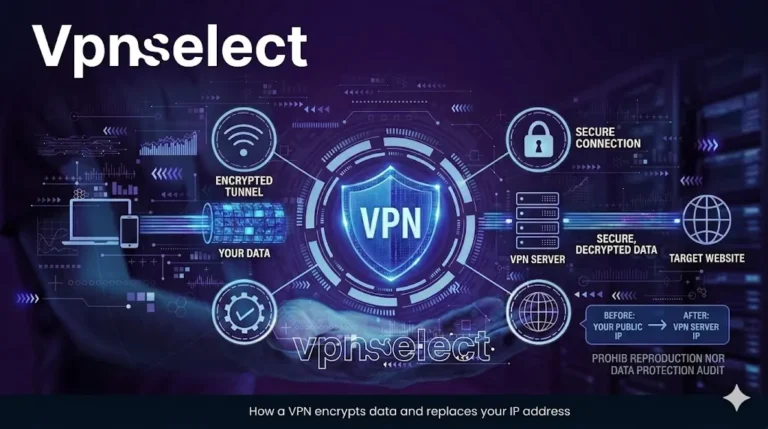

An IPsec VPN is a virtual private network that uses the Internet Protocol Security suite to encrypt and authenticate data between two devices over the public internet. It operates at the network layer – securing every IP packet regardless of the application – making it the go-to standard for site-to-site corporate connections and remote access infrastructure. This guide covers how it works, the two tunnel modes, and when IPsec is the right protocol to use.
What Is an IPsec VPN?
An IPsec VPN is a network security solution that combines the IPsec protocol suite with VPN tunneling to create encrypted, authenticated connections between endpoints over public infrastructure. Developed by the IETF in the early 1990s, IPsec was built directly into the IP stack – it protects all IP-based traffic at the network layer without requiring changes to the applications sending that traffic.
In practice, IPsec VPN covers two deployment patterns: a site-to-site VPN, where two gateways build a permanent encrypted tunnel between entire networks, and a remote access VPN, where individual devices connect via a VPN client to reach a private corporate network. For a broader overview of how VPNs work as a category, see this VPN guide.
How Does an IPsec VPN Work?
An IPsec VPN works through a two-phase negotiation process governed by the Internet Key Exchange (IKE) protocol, alongside two core security protocols – AH and ESP. Phase 1 builds a secure control channel; Phase 2 uses it to set up the actual data tunnel.
Key Components of IPsec (IKE, AH, ESP)
IPsec is a framework of three components, each handling a specific security function.
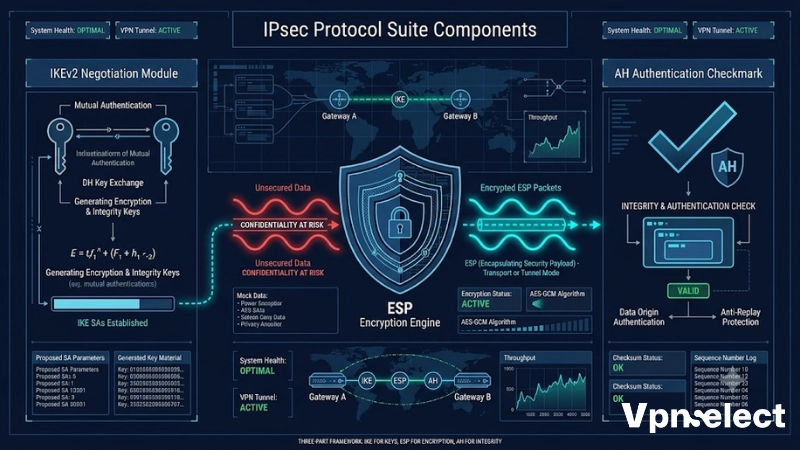
Internet Key Exchange (IKE) manages negotiation between endpoints. IKE Phase 1 establishes a management tunnel for key exchange; IKE Phase 2 negotiates the actual VPN encryption algorithms and session keys. IKEv2 is the current standard – faster reconnection and built-in NAT traversal over its predecessor.
Authentication Header (AH) verifies packet integrity and source authenticity but provides no encryption. Rarely used alone in modern deployments.
Encapsulating Security Payload (ESP) handles encryption, authentication, and anti-replay protection in one protocol. Most deployments run ESP with AES-256 and SHA-2 – this is where the actual confidentiality of an IPsec VPN comes from.
How the IPsec Handshake Establishes a Secure Tunnel
The tunnel lifecycle runs five steps. First, outbound traffic destined for the remote network triggers the process. Second, IKE Phase 1 authenticates both peers (via pre-shared key or certificate) and builds the IKE Security Association (SA). Third, IKE Phase 2 negotiates IPsec SA parameters – cipher, hash, and session keys. Fourth, data flows through the encrypted tunnel per the agreed SA. Fifth, SAs expire after a set lifetime (typically 1-8 hours) and are renegotiated or torn down – limiting the blast radius of any compromised session key.
What Are the Two IPsec Tunnel Modes?
IPsec VPNs run in two modes – Tunnel Mode and Transport Mode – differing in how much of the original IP packet gets encrypted.
Tunnel Mode
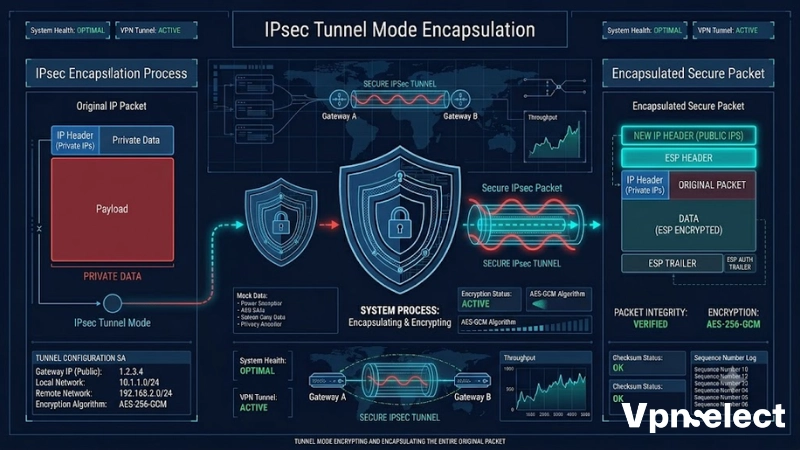
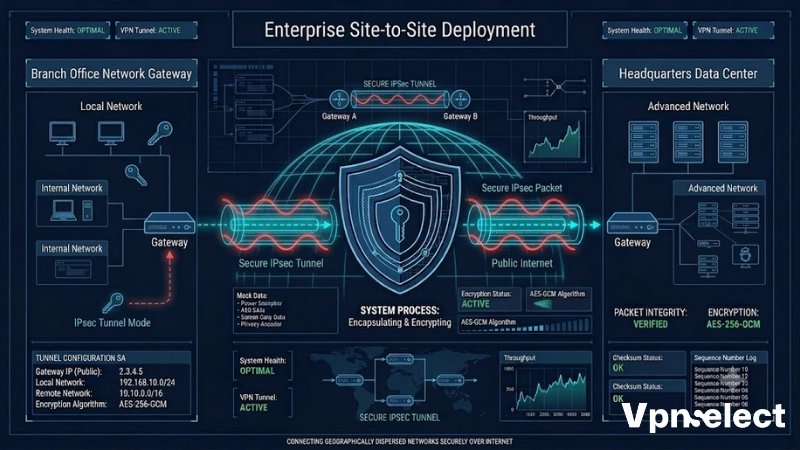
Tunnel Mode encrypts the entire original IP packet – header and payload – then wraps it inside a new outer IP packet with fresh routing headers. Intermediate routers see only the outer destination address; the original source, destination, and metadata are completely hidden.
This is the default for all site-to-site and remote access VPN protocol deployments. It works across NAT devices and lets gateway hardware manage encryption on behalf of entire networks – individual endpoints do not need to run IPsec themselves.
Transport Mode
Transport Mode encrypts only the packet payload, leaving the original IP header visible. Intermediate routers read the header and route normally, with no re-encapsulation overhead.
This suits direct host-to-host communication inside a trusted environment – securing a Remote Desktop session between two internal servers, for example. Because the original IP header is exposed, Transport Mode is not suitable for internet-facing connections or NAT scenarios.
When Should You Use an IPsec VPN?
IPsec VPN fits three scenarios where network-layer security and enterprise compatibility outweigh setup simplicity.
Branch office or data center links. Site-to-site IPsec tunnels connect geographically dispersed networks without leasing private lines. Gateways handle encryption transparently; traffic behaves as if it is on a local network.
Remote workforce access. An IPsec remote access VPN gives employees a standards-compliant, auditable connection to internal resources – integrating cleanly with existing identity and firewall infrastructure.
Compliance-driven environments. HIPAA, PCI-DSS, and government mandates require encrypted data in motion. IPsec’s NIST-documented standards and long audit history (see NIST SP 800-77) make it a defensible choice in any compliance review.
IPsec VPN vs. Other Protocols
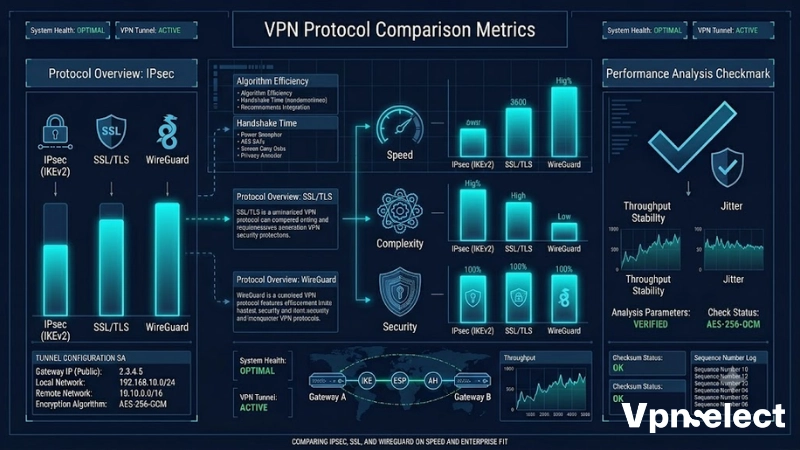
IPsec leads on enterprise compatibility, SSL/TLS wins on clientless simplicity, and WireGuard tops raw performance in 2026.
The table below covers the three most common VPN protocols across the criteria that drive real infrastructure decisions. Use it to pick the right fit rather than defaulting to whatever was already installed.
| Criteria | IPsec (IKEv2) | SSL/TLS (OpenVPN) | WireGuard |
| OSI layer | Network (L3) | Application (L7) | Network (L3) |
| Encryption | AES-256 + SHA-2 | AES-256 + SHA-2 | ChaCha20 + Poly1305 |
| Speed | Fast | Moderate | Fastest |
| NAT traversal | Built-in (IKEv2) | Supported | Supported |
| Client required | Dedicated app | Browser or app | Dedicated app |
| Best fit | Site-to-site, enterprise | Clientless remote access | Speed-critical workloads |
SSL VPNs connect through a browser – no install required – making them practical for contractors or unmanaged devices. IPsec needs a dedicated client, which is standard in managed environments. WireGuard’s ~4,000-line codebase cuts the attack surface considerably versus IPsec’s complexity, though it lacks some enterprise features natively. For a full breakdown by risk profile, see the most secure VPN protocol guide.
Is IPsec VPN Safe to Use in 2026?
IPsec VPN is safe in 2026 when configured correctly. AES-256, SHA-2, and IKEv2 have no known practical breaks. The “Port Fail” vulnerability from 2015 – which could leak a user’s real IP – was patched by all major providers within weeks and is non-issue in any maintained implementation. Older IKEv1 configs with weak pre-shared keys remain a real risk, but that is a legacy misconfiguration problem, not a protocol flaw.
On provider specifics: NordVPN excludes IPsec from its app protocols for internal security reasons, routing users toward Meshnet for direct tunneling. ExpressVPN supports IKEv2 natively with router workarounds available. CyberGhost dropped IPsec from its consumer lineup in favor of WireGuard and OpenVPN. The bottom line: IPsec is enterprise-grade secure with IKEv2, strong ciphers, and current firmware. The risk is misconfiguration, not the protocol itself. For consumers, a current client from VPN Select defaults to IKEv2 or WireGuard automatically.


Leave a comment