

























How Does a VPN Work by creating an encrypted tunnel between your device and a remote server, routing all your internet traffic through that server while replacing your real IP address with the server’s IP. When you connect, your data is encrypted before it leaves your device, meaning anyone who intercepts it sees only unreadable ciphertext. This three-part mechanism – encrypt, tunnel, and hide your IP – is what makes a VPN the most effective tool for online privacy today. By reading this guide, you will understand the technical architecture and practical applications of this essential security tool.
What Is a VPN and What Does It Do?
A VPN (Virtual Private Network) is a privacy tool that encrypts your internet traffic and hides your IP address by routing your connection through a secure remote server. Understanding How Does a VPN Work at a high level helps users protect themselves from ISP tracking and cyber threats.
What Problem Does a VPN Solve?
The core problem a VPN solves is exposure – by default, your traffic is visible to your ISP, network administrators, advertisers, and attackers on the same network. Without a VPN, your browsing history can be logged by your ISP, your credentials intercepted on public Wi-Fi, and your location used to enforce geo-restrictions. How Does a VPN Work to fix this? It addresses all of these simultaneously: it encrypts traffic so interceptors see noise, hides activity from your ISP, and replaces your IP to bypass geographic blocks.
Is a VPN the Same as Private Browsing?
No, a VPN and private browsing (Incognito mode) are entirely different tools. Private browsing only stops your browser from saving local history and cookies – it does nothing to hide your activity from your ISP or websites. How Does a VPN Work differently is by operating at the network level, encrypting all traffic leaving your device regardless of which app sends it. To truly understand what is a vpn, one must recognize that it provides external privacy, while private browsing provides local privacy.
How Does a VPN Encrypt Your Internet Traffic?
Encryption uses AES-256 – the same standard used by governments for classified data – to convert your readable traffic into an unreadable cipher. When you connect, your VPN client and server perform a cryptographic handshake to exchange a session key. How Does a VPN Work during this stage ensures that every packet you send is encrypted with that key before leaving your device; only the VPN server can decrypt it.
How Does a VPN Tunnel Wrap and Route Your Data?
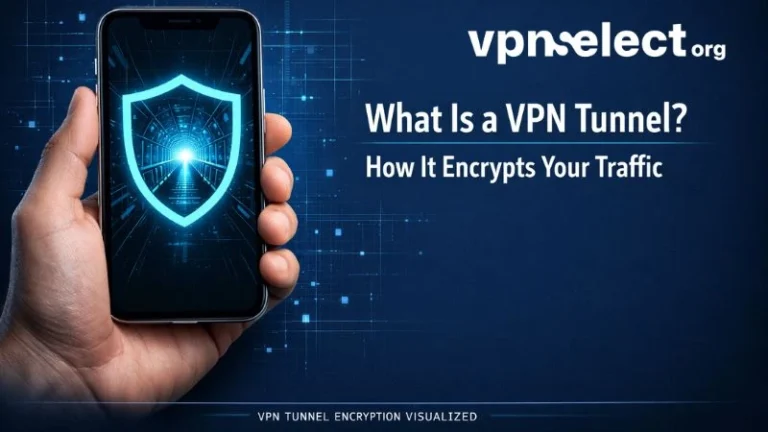
Tunneling wraps your encrypted packet inside an outer packet addressed to the VPN server. Every router and ISP handling the packet in transit only sees the outer wrapper – not your original content or destination. How Does a VPN Work in this tunneling phase is crucial for bypassing censorship, as the destination appears to be the VPN server rather than a restricted site. The VPN server strips the wrapper, decrypts the packet, and forwards your request to the actual website.
How Does a VPN Hide Your IP Address?
IP hiding happens because the destination website receives the request from the VPN server’s IP address, not yours. The website sees only the server’s location and identity, effectively masking your real geographical footprint. How Does a VPN Work to maintain this mask is simple: your real IP remains hidden for as long as the VPN connection stays active.

What VPN Protocols Determine How a VPN Works?
VPN protocols are the technical rulebooks governing how the encrypted tunnel is built, authenticated, and secured during data transmission. These protocols directly dictate How Does a VPN Work in terms of the balance between speed, security, and device compatibility.
What Are the Most Common VPN Protocols and How Do They Differ?
The major VPN protocols – WireGuard, OpenVPN, and IKEv2 – each offer a distinct balance of performance and security. Understanding these differences is vital when choosing what is a vpn provider for your specific needs.
How Does a VPN Work with different protocols can be summarized in the table below:
The following table compares the most popular VPN protocols used by Best VPN services today. Use this to determine which protocol matches your priority for speed or security.
| Protocol | Speed | Security | Best For |
| WireGuard | Very Fast | High (Modern) | Everyday use and streaming |
| OpenVPN | Moderate | Very High | Maximum security environments |
| IKEv2/IPSec | Fast | High | Mobile devices switching networks |
| PPTP | Fast | Low (Obsolete) | Do not use; fundamentally broken |
WireGuard is now the preferred choice for consumer VPNs because its ~4,000-line codebase is vastly simpler than OpenVPN’s 70,000+ lines, resulting in faster speeds. OpenVPN remains the gold standard for high-trust environments due to two decades of security audits.
Does the VPN Protocol Affect Speed and Security?
Yes, the protocol choice significantly impacts both dimensions. WireGuard typically achieves speeds within 10–15% of an unprotected connection, while older protocols or OpenVPN over TCP can reduce speeds by 30–50% on high-latency connections. How Does a VPN Work efficiently depends on minimizing this overhead; therefore, most reputable services select the best protocol automatically based on your network conditions. For more details on protocol configuration, refer to a comprehensive VPN Guide.

How Does a VPN Work in Practice – Common Use Cases?
In practice, How Does a VPN Work depends entirely on context – corporate remote access and consumer privacy VPNs share the same technology but operate with different architectures. Whether you are a business traveler or a home user, the application remains one of the most practical tools available today.
How Does a VPN Work for Remote Employees Accessing a Company Network?
For remote employees, a VPN extends the company’s private internal network to the employee’s device, making a home laptop appear as though it’s physically in the office. The employee authenticates through the VPN client, receives a private IP address from the company’s internal address space, and gains access to internal file servers. How Does a VPN Work in this enterprise setting often involves “split tunneling,” where only corporate traffic routes through the tunnel to save bandwidth.
How Does a VPN Service Work for Individual Users?
For individuals, [how does a vpn service work] by routing all device traffic through a shared server pool operated by a provider. The ISP sees only encrypted traffic going to the VPN server, while websites see the server’s IP. This is why people seek best free vpns or premium services – to secure public Wi-Fi and bypass geo-restrictions. How Does a VPN Work for the average user ensures that their search queries and file uploads remain private from local snoopers.

How Does a VPN Work Differently Across Devices and Network Environments?
While the same encryption principles apply, [how does a vpn network work] varies meaningfully across different operating systems like iOS and Android. How Does a VPN Work at the system level is determined by the specific APIs and frameworks provided by the device manufacturer.
How Does a VPN Work on iPhone and iOS Devices?
On iPhone, a VPN works through Apple’s Network Extension framework, which gives the VPN app system-level access to intercept all network traffic. If you want to know [how does a vpn work on iphone], it is often via the IKEv2 protocol which is natively supported in iOS settings. How Does a VPN Work on iOS also allows for “Always-on” profiles in enterprise environments, though some push notification traffic may occasionally bypass the tunnel due to Apple’s system architecture.
How Does a VPN Work on Android Compared to iPhone?
Android uses the VpnService API to achieve similar results but with greater flexibility than iOS. How Does a VPN Work on Android often includes a built-in Kill Switch in the system settings that blocks all traffic if the VPN drops unexpectedly. Furthermore, Android allows for per-app split tunneling, letting users exclude specific apps from the encrypted tunnel – a feature that is more granular than what is typically available on iOS consumer apps.
How Does a VPN Work at the Router Level?
At the router level, a VPN client runs on the hardware itself, meaning every connected device – including smart TVs and IoT devices – is protected. How Does a VPN Work here is by centralizing the encryption process, though it can reduce speeds if the router’s processor is not powerful enough to handle the overhead.
How Does a VPN Handle NAT and Private IP Addresses?
Most home networks use NAT (Network Address Translation) to share one public IP across multiple devices. A VPN works alongside NAT; the router forwards VPN packets using its public IP, while the VPN server maintains the tunnel. How Does a VPN Work with NAT sometimes requires NAT-Traversal (NAT-T) to wrap packets in a way that prevents integrity checks from breaking when headers are modified. In corporate setups, the device receives a virtual private IP from the company’s subnet, making it a functional member of the internal network.

Wrapping Up
Understanding How Does a VPN Work reveals that it is a multi-layered tool involving AES-256 encryption, secure tunneling, and IP masking. From protecting your data on public Wi-Fi to bypassing regional censorship and securing corporate networks, a well-chosen VPN is essential for modern digital life. Always prioritize providers with audited no-logs policies and robust protocols like WireGuard to ensure your privacy remains intact.
Ready to secure your connection with a top-tier provider? Visit VPNSelect to compare the industry’s most reliable options and find the perfect fit for your privacy needs.


Leave a comment