























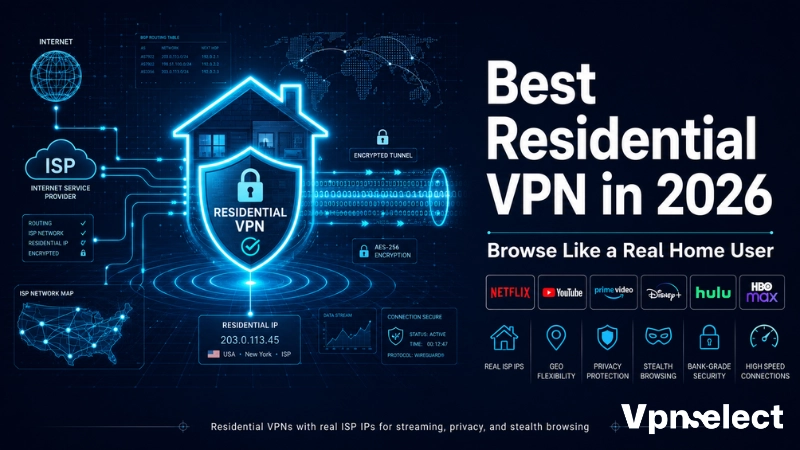
The best residential VPN in 2026 gives you a real ISP-assigned IP, so streaming sites, banks, and shops treat you like a regular home user.
What Is a Residential VPN and How Does It Work?
A residential VPN is a privacy service that routes your traffic through IP addresses assigned by real internet service providers to home users, making your connection look like ordinary household traffic to any website you visit.
To understand why this matters, it helps to look at how residential IPs differ from regular VPN IPs and how the routing process works behind the scenes.
What Is a Residential IP Address?
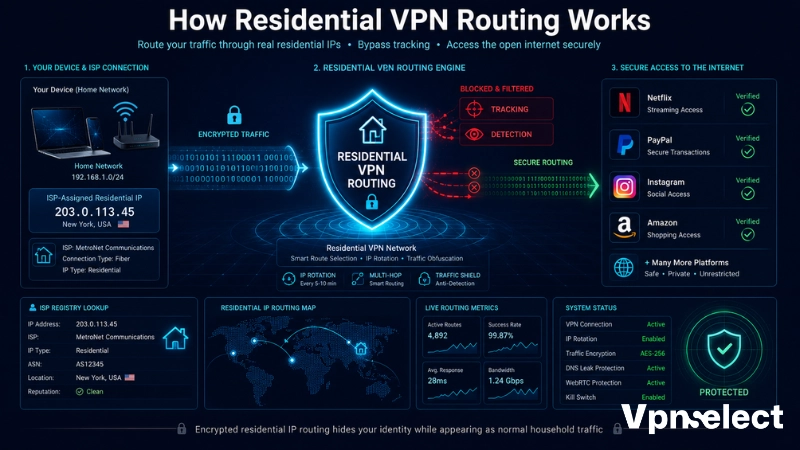
A residential IP address is a public IP assigned by an internet service provider (ISP) to a home connection, tied to a physical location and listed in ISP registries as a consumer line. Major sites like Netflix, PayPal, and Instagram trust these IPs by default because they come from real users.
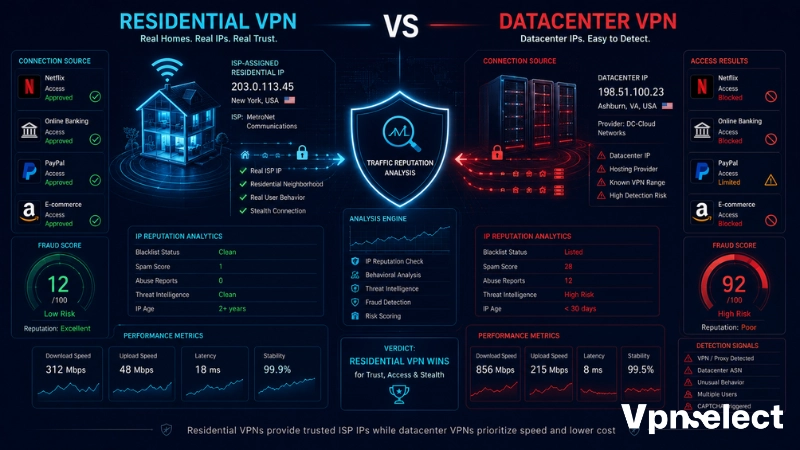
The opposite is a datacenter IP, which originates from a cloud or hosting provider. Anti-fraud systems flag datacenter ranges quickly, which is why most regular VPNs get blocked by streaming services and banks within days of a new server going live.
How Does a Residential VPN Route Your Traffic?
A residential VPN forwards your encrypted traffic through a peer network or partner ISP node, then exits onto the open internet using that node’s real residential IP. Your original IP is hidden behind AES-256 encryption, and the destination site sees only the residential exit IP.
Most providers use either a decentralized peer-to-peer model (where volunteer home users share bandwidth in exchange for tokens) or a managed partner network (where the provider pays ISPs or app developers for IP access). Both approaches deliver the same outcome: undetectable residential traffic on the public web.
Is a Residential VPN Better Than a Regular VPN?
A residential VPN is generally better than a regular VPN for tasks where the destination website checks IP reputation, since it avoids the blacklists that frequently flag datacenter VPN IPs. For pure privacy and speed on trusted sites, a regular VPN is usually faster and cheaper.
The right choice depends entirely on what you plan to do. Below, we compare the two main alternatives so you can decide. For a broader look at the full VPN category, our Best VPN hub covers every tested type, including obfuscated, double-hop, and standard commercial options.
Residential VPN vs Datacenter VPN: Which One Should You Use?
Residential VPN wins on stealth and IP reputation, while datacenter VPN wins on speed and price. If your goal is to access geo-restricted streaming, manage multiple social or e-commerce accounts, or verify ads from different regions, a residential VPN is the right tool.
Datacenter VPNs (such as NordVPN, Surfshark, or ExpressVPN on their standard plans) are still the better choice for everyday browsing, torrenting, and bypassing simple geo-blocks where raw speed matters more than IP type.
Residential VPN vs Residential Proxy: What Is the Difference?
A residential VPN encrypts all device traffic and routes it through residential IPs system-wide, while a residential proxy only routes traffic from a specific app or browser and typically lacks full encryption. VPNs are simpler for everyday use; proxies are more flexible for automation tools and scraping setups.
What Are the Best Residential VPN Providers in 2026?
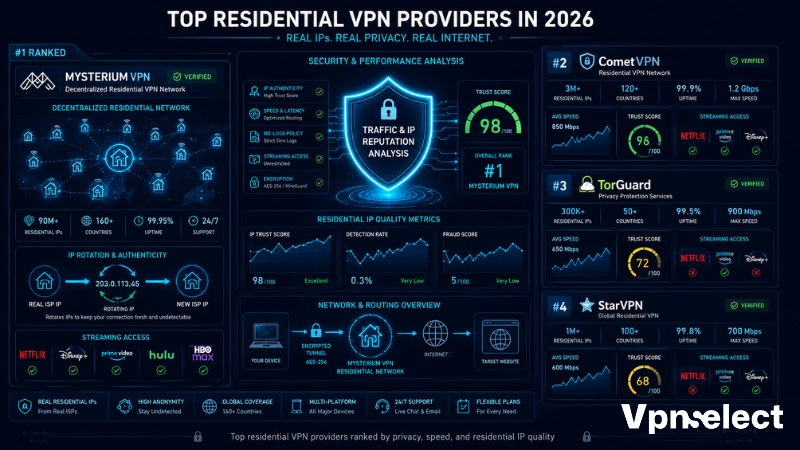
Four residential VPN providers stand out in 2026: Mysterium VPN, CometVPN, TorGuard, and StarVPN. Each was evaluated on IP pool size, residential authenticity, speed, no-logs policy, and price-per-IP value.
Below, we break down what each provider does best, so you can pick the one that fits your workflow. A solid choice should also align with what you would expect from any best no logs VPN on the market today.
Mysterium VPN – Best True Residential VPN Overall
Mysterium VPN is the most authentic residential option, running a fully decentralized peer-to-peer network where every exit node is a real home user. The dVPN model means there is no central server log, and IPs cover 100+ countries through volunteer hosts.
Speeds vary by node, typically 30-80 Mbps, which is enough for streaming and account management but not the fastest for heavy downloads. Payment is pay-as-you-go with crypto, so there is no subscription lock-in.
CometVPN – Best Affordable Residential VPN
CometVPN offers the lowest entry price among residential VPN providers, with monthly plans starting around $9.99 for unlimited bandwidth on a curated residential IP pool. It is the easiest pick for casual users who want a residential IP without paying enterprise rates.
The provider supports WireGuard and OpenVPN, includes a kill switch, and unblocks major streaming platforms without manual configuration.
TorGuard – Best for Dedicated Static Residential IP
TorGuard is the top choice if you need a dedicated static residential IP that does not rotate. The provider partners with US, UK, and Canadian ISPs to offer single-user residential IPs starting at $13.99/month, ideal for managing payment accounts or remote work logins that flag IP changes.
TorGuard also includes Stealth VPN obfuscation, AES-256 encryption, and an independent no-logs audit from 2024.
StarVPN – Best for Enterprise and Large IP Pool
StarVPN serves the enterprise tier with one of the largest residential IP pools available (90M+ rotating IPs across 195 locations). It is built for ad verification, brand protection, market research, and large-scale scraping workflows rather than personal use.
Pricing is volume-based and starts higher than consumer options, but per-request costs drop significantly at scale.
How Do You Choose the Best Residential VPN for Your Needs?
Choosing the best residential VPN comes down to three factors: your primary use case (streaming, scraping, account management), the IP pool size and rotation policy you require, and the security features bundled with the service.
Below, we walk through the three questions most readers ask before subscribing.
Which Residential VPN Is Best for Streaming?
Mysterium VPN and CometVPN both unblock Netflix US, Hulu, and BBC iPlayer reliably, since their residential IPs sit outside streaming-platform datacenter blacklists. Mysterium is better for niche regions, while CometVPN wins on consistent speed for 4K playback.
Is a Residential VPN Good for Web Scraping?
Residential VPNs work well for web scraping at small to medium scale, because residential IPs trigger fewer CAPTCHA challenges and have far lower block rates than datacenter alternatives. For very large-scale scraping (millions of requests), a dedicated residential proxy network is usually more cost-effective than a VPN.
What Security Features Should a Residential VPN Have?
Look for AES-256 encryption, a verified no-logs policy, kill switch, DNS leak protection, and IPv6 leak protection. A bonus is bundled malware filtering, similar to what you would expect from a best VPN with antivirus product, which blocks tracker and phishing domains at the DNS layer.
Independent audits (Mysterium and TorGuard have both completed them) are the strongest signal that the no-logs claim is real.
Are Residential VPNs Legal and Safe to Use?
Residential VPNs are legal in most countries, including the US, EU, and Vietnam, but their safety depends entirely on whether the provider sources IPs ethically and runs an audited no-logs policy. Using a residential VPN does not anonymize illegal activity, and the question of whether can VPN be traced ultimately comes down to logging practices and jurisdiction.
Stick with providers that publicly document their IP sourcing (consented peer networks or licensed ISP partnerships) and avoid free residential services, which often resell user bandwidth without informed consent.
What Should Vietnam Users Know Before Choosing a Residential VPN?
Vietnam users should check four things before subscribing: whether the residential VPN works on local ISP networks, whether it uses decentralized or centralized infrastructure, how IP fraud scoring affects exit nodes, and the ethical sourcing of residential peers.
Each factor below carries unique weight for users connecting from Hanoi, Da Nang, or Ho Chi Minh City.
Does a Residential VPN Work in Vietnam?
Residential VPNs work in Vietnam, but only providers with obfuscation can reliably bypass Bamboo Firewall DPI inspection. Mysterium and TorGuard both offer obfuscated protocols, while CometVPN works through standard WireGuard on most ISPs without issues.
How Is a Decentralized Residential VPN Different?
A decentralized residential VPN (dVPN) routes traffic through volunteer peers rather than company-owned servers, removing the central log point entirely. Mysterium is the clearest example; users connect to home devices owned by other Mysterium participants.
The trade-off is variable speed and the responsibility of choosing reputable nodes from the available network.
What Is an IP Fraud Score and Why Does It Matter?
An IP fraud score is a 0-100 rating from anti-fraud services (IPQS, MaxMind) measuring how risky an IP looks to websites. Residential IPs typically score 0-25, while datacenter IPs score 75-100, which is why streaming sites trust the former and block the latter on sight.
Is It Ethical to Use a Peer-to-Peer Residential VPN?
Peer-to-peer residential VPNs are ethical only when the network publicly documents informed consent from every node operator. Mysterium and licensed partner networks meet this bar; free residential apps that secretly resell user bandwidth do not.
For full provider comparisons, regional buying guides, and updated speed benchmarks, head over to VPN Select and pick the residential plan that fits your needs best.






Leave a comment