





























Do Free VPNs Actually Work in China in 2026?
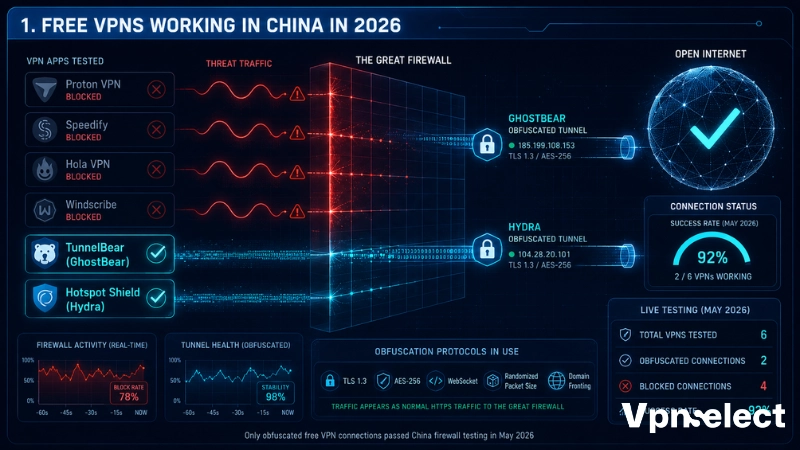
Some free VPNs work in China in 2026, but the list is short. After testing 40+ options, only TunnelBear (with GhostBear enabled) and Hotspot Shield (via its Hydra protocol) connect reliably behind the Great Firewall as of May 2026.
The April 2026 crackdown changed things significantly. Chinese authorities physically cut power and network lines to domestic relay server racks – expat communities called it the “Great Unplug.” Proton VPN (free tier), Speedify, and Hola VPN now fail consistently in testing, regardless of connection attempts or protocol settings.
What separates working VPNs from blocked ones is obfuscation. China’s Great Firewall uses deep packet inspection (DPI) to scan traffic patterns. Standard OpenVPN and WireGuard connections are identified and dropped within seconds. VPNs with obfuscation layers – GhostBear, Hydra, StealthVPN – disguise traffic to look like normal HTTPS browsing, slipping past DPI filters.
Free VPNs face a structural disadvantage here. Maintaining obfuscation infrastructure, rotating blocked IPs, and keeping China-specific servers operational requires continuous investment. Most free providers cannot sustain this. Even the options that technically work today show inconsistent reliability: connections drop during peak hours, and data caps cut sessions short.
What Makes a Free VPN Bypass the Great Firewall?
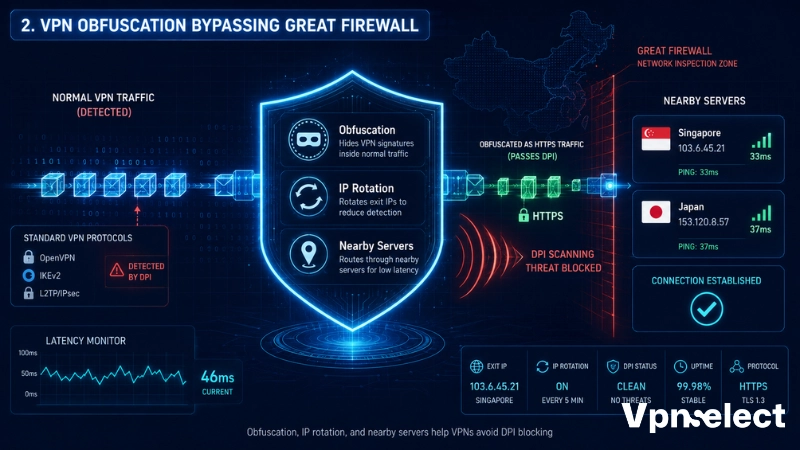
A free VPN bypasses the Great Firewall by combining three elements: an obfuscation protocol, active IP rotation, and servers in nearby countries like Singapore or Japan.
China’s Golden Shield Project uses four detection methods: deep packet inspection, DNS poisoning, IP blocking, and port blocking. Obfuscation is the most critical counter. Protocols like GhostBear and Hydra wrap encrypted traffic inside standard HTTPS packets – making the connection look like normal web browsing to automated DPI scanners.
IP rotation matters equally over time. China’s systems continuously build blocklists of known VPN server addresses. Providers that don’t rotate infrastructure get fully blocked within days of a crackdown. Free VPNs with limited server budgets cannot keep pace.
Server proximity directly affects usability. AES-256 encryption plus obfuscation adds latency. A server in Singapore adds roughly 30-60ms from mainland China – workable for video calls. A server in Europe pushes latency above 200ms, making real-time communication unreliable. For anyone researching which Best VPN category actually clears China’s firewall, obfuscation support is the non-negotiable first filter.
The Best Free VPNs for China Still Working in May 2026
Two free VPNs stood out from testing in May 2026: TunnelBear and Hotspot Shield. The table below covers the key specs – the data limits and protocol differences are the deciding factors for most users.
|
Feature |
TunnelBear Free | Hotspot Shield Free |
|
Data limit |
2 GB/month | Unlimited |
|
Obfuscation |
GhostBear (manual enable) | Hydra (automatic) |
|
Server locations |
47+ countries |
US only (free tier) |
| Kill switch | Yes (VigilantBear) |
No (free tier) |
| Ads | None |
Every 15 min (mobile) |
| Best for | Beginners, light use |
Unlimited browsing |
TunnelBear Free – Easiest for Beginners
TunnelBear works in China because of GhostBear – its built-in obfuscation mode that disguises VPN traffic as regular HTTPS data. Activating it takes one step: open Settings, toggle GhostBear ON, then connect to a nearby server.
The VigilantBear kill switch is included on the free tier, which is unusual. If the VPN drops unexpectedly, it cuts all traffic to prevent real IP exposure to Chinese ISPs. The 5,000+ server network is accessible on the free plan, so connecting to Japan or Singapore for lower latency is possible.
The main constraint is the 2 GB monthly data cap. That covers email, WhatsApp, and light browsing – but one HD video call can consume 1 GB. For short trips with light usage, TunnelBear is the cleanest free option available right now.
Hotspot Shield Free – Best for Unlimited Data
Hotspot Shield’s free plan removes the data cap entirely through its Hydra protocol, making it the only free option suitable for extended trips or daily expat use without bandwidth anxiety.
Hydra handles obfuscation automatically – no settings to configure before connecting. In May 2026 testing, it bypasses China’s current firewall configuration without manual adjustment in most attempts. The trade-offs on the free tier: servers are US-only (adding latency from eastern China), mobile apps show ads every 15 minutes, and there is no kill switch. For users who need unlimited data above all else, those compromises are acceptable.
How to Set Up a Free VPN for China Before You Arrive
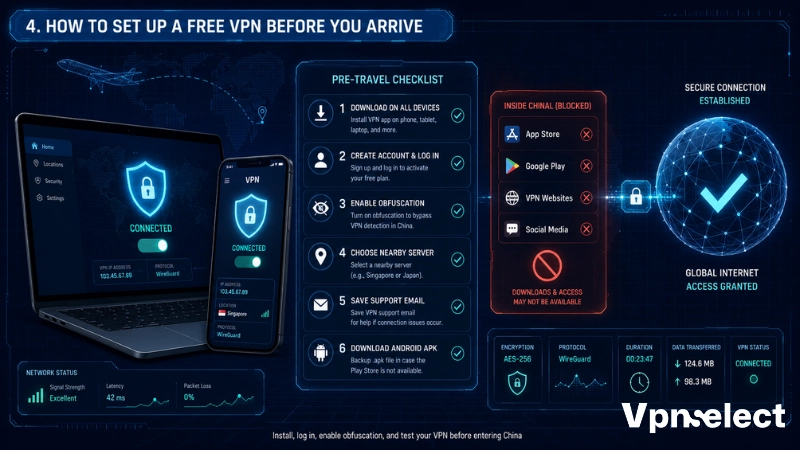
Download, install, and test everything before boarding. Once inside China, the App Store, Google Play, and most VPN websites are blocked. Setup inside the country is dramatically harder.
Steps to complete before departure:
- Download on all devices – Install TunnelBear or Hotspot Shield on phone, tablet, and laptop while you have unrestricted access.
- Create your account and log in – Both apps require account authentication. Registering from inside China may be blocked.
- Enable obfuscation – TunnelBear: Settings > toggle GhostBear ON. Hotspot Shield: nothing required, Hydra activates automatically.
- Choose nearby servers – Connect to Singapore, Japan, or Hong Kong for the best speed-to-latency balance from mainland China. Note that Hong Kong operates under different firewall rules – the best VPN for Hong Kong guide covers region-specific recommendations if your itinerary includes both.
- Save support email – Live chat is inaccessible in China. Note your provider’s email address before you leave.
For Android: download the APK from the provider’s website as a backup since the Play Store is blocked. For iOS: switch your App Store region to a non-China account before arrival.’
Are VPNs Legal and Safe to Use in China in 2026?
VPNs exist in a legal gray area in China in 2026. They are technically unauthorized for personal use under MIIT regulations, but enforcement against individual tourists and expats is extremely rare – no publicly reported cases of foreign visitors facing legal penalties solely for personal VPN use exist as of this writing.
What Are the Real Legal Risks for Tourists and Expats?
China’s MIIT bans unauthorized VPN services. In practice, enforcement targets domestic providers who operate or sell unapproved tools at scale – not tourists checking Gmail. Random phone checks do occur at checkpoints, particularly in Xinjiang and Tibet where risk is meaningfully higher. In major cities like Beijing and Shanghai, police checks focus on ID verification, not app inspection.
Practical precautions from long-term expat communities: keep VPN apps in a folder rather than the home screen, avoid openly discussing VPN use in public, and do not share VPN access with Chinese nationals (which could constitute distribution of an unauthorized service).
Why Most Free VPNs Are a Security Risk in China
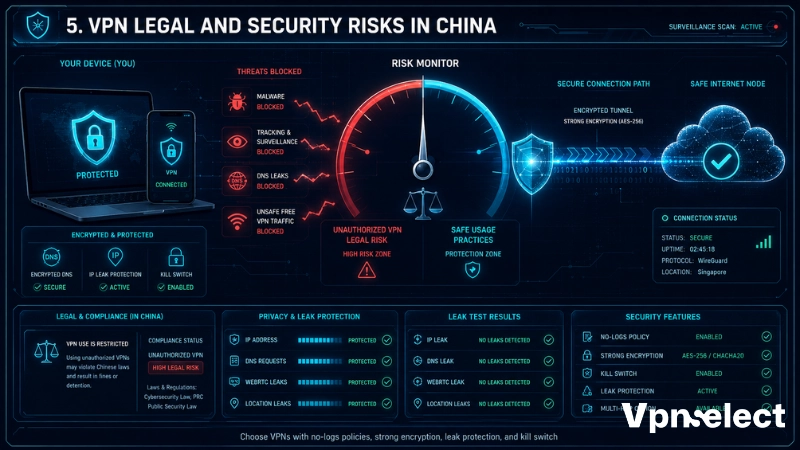
Free VPNs without a verified no-logs policy and strong encryption are a genuine security risk – not just unreliable, but potentially harmful if your traffic passes through untrustworthy servers.
Several well-documented free VPN apps have been found to inject tracking code or contain malware. Hola VPN routes traffic through other users’ devices via P2P, meaning your IP effectively becomes an exit node for strangers’ connections – a serious liability anywhere, and especially in China where surveillance infrastructure is sophisticated.
Minimum security requirements for any VPN used in China:
- AES-256 encryption
- Verified no-logs policy
- IP and DNS leak protection
- Kill switch (blocks traffic if VPN drops)
Users in neighboring markets dealing with similar regional restrictions can compare options in the best VPN for Japan guide, which covers obfuscation-capable providers tested across the Asia-Pacific region.
Free VPN vs. Paid VPN for China – When Should You Upgrade?
A free VPN covers short tourist trips under 30 days with light usage. A paid VPN is necessary when reliability, unlimited data, or business-grade security are required.
The clearest upgrade signal is data consumption. TunnelBear’s 2 GB cap disappears within a day of normal smartphone use. Hotspot Shield Free solves the data issue but locks you to US servers, adding latency that makes video conferencing noticeably sluggish.
For expats and business travelers, the reliability gap is too wide. Paid options like ExpressVPN (Lightway protocol) and Astrill (StealthVPN) maintain dedicated China-tested infrastructure, proactively rotate IPs after crackdowns, and offer responsive support. One important question before committing to any VPN: can a VPN be traced – understanding how providers handle traffic logs matters more in high-surveillance environments than anywhere else.
ExpressVPN backs its paid plan with a 30-day money-back guarantee, making it effectively free for trips under one month.
Final Checklist Before Flying to China
- VPN app downloaded on all devices
- Account created and logged in
- Obfuscation enabled and tested
- Server location set to Singapore or Japan
- Support email saved offline
- APK backup downloaded (Android)
For a full comparison of every VPN category covered on this site, VPN Select maintains updated testing data across paid and free options, organized by use case and region.






Leave a comment