









After testing 40+ VPN services, the 7 best anonymous VPNs in 2026 are NordVPN, Mullvad, ProtonVPN, ExpressVPN, Surfshark, IVPN, and Private Internet Access – each verified through independent no-log audits and real court cases. For a broader starting point, the VPN Select homepage covers all major categories.
Not every VPN marketed as “private” actually protects you. The difference between a truly private VPN service and a risky one comes down to four hard criteria: verified no-logs policy, RAM-only servers, anonymous payment support, and jurisdiction outside 14-Eyes alliances.
For users in high-risk environments – journalists, activists, or anyone bypassing censorship – the Best VPN overview provides additional context on how these services compare across performance metrics beyond privacy alone.
What Is an Anonymous VPN and How Does It Work?
An anonymous VPN routes your internet traffic through an encrypted tunnel, strips your real IP address, and retains zero identifying logs about your activity or connection. It works by assigning you a shared IP address from its server network, making individual user behavior indistinguishable from thousands of others on the same node.
Privacy vs. Anonymity – Why No VPN Is 100% Anonymous
Privacy means a VPN hides the content of your traffic. Anonymity means no one can link that traffic back to you. The critical distinction: privacy is achievable; complete anonymity is not. A VPN provider still knows your payment method, your account creation timestamp, and often your email address. Even with a no-logs policy, metadata at the network infrastructure level can expose behavioral patterns.
Understanding what is vpn encryption at a technical level clarifies exactly how much protection the tunnel itself provides – and where its limits begin.
The 4 Criteria That Define a Truly Private VPN
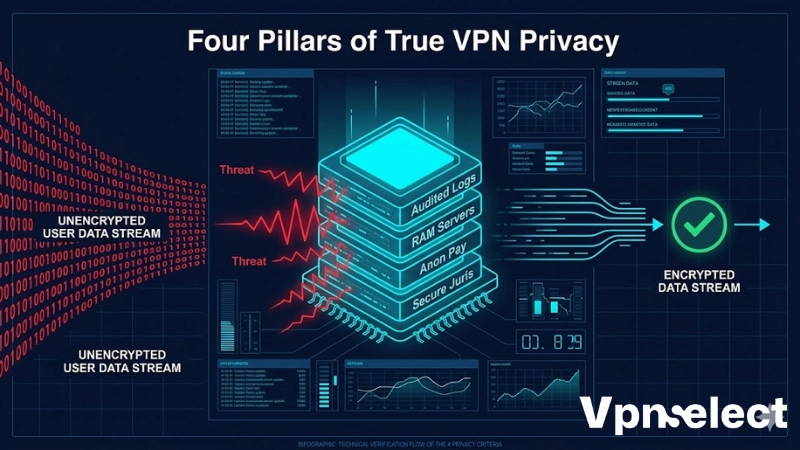
The 4 criteria that define a truly private VPN are: verified no-logs policy audited by third parties, RAM-only server infrastructure, anonymous signup and payment options, and jurisdiction in a privacy-friendly country outside intelligence-sharing alliances.
- Verified no-logs policy: Audited by firms like Cure53, KPMG, or Deloitte – not self-certified
- RAM-only servers: All session data is wiped automatically on reboot; no data survives seizure
- Anonymous payment: Accepts Monero, Bitcoin, or physical cash – no financial identity trail
- Jurisdiction: Based outside the 5/9/14-Eyes countries, or with proven legal resistance to data requests
How We Tested and Ranked These VPNs
We ranked these VPNs using 6 objective criteria: audit transparency, server infrastructure type, payment anonymity, jurisdiction risk, court-tested no-logs history, and real-world performance under censorship conditions.
Each provider was evaluated against leaked legal requests, warrant canary status, and published audit reports. Services that only offered self-reported privacy policies without third-party verification were excluded regardless of reputation. Speed, device support, and pricing were treated as secondary factors – anonymity and verified privacy came first.
The 7 Best Anonymous VPNs of 2026 – Ranked and Reviewed
The 7 best anonymous VPNs of 2026 are ranked by audit depth, infrastructure integrity, and proven no-logs performance: NordVPN leads overall, Mullvad leads for true anonymity, and each remaining provider excels in a specific use case.
NordVPN – Best Overall (RAM-Only, Dual Audits, Post-Quantum)
NordVPN earns the top spot through dual independent audits by Deloitte and VerSprite, a fully RAM-only server network, and post-quantum encryption support introduced in 2024. Its no-logs policy has been verified through real-world legal pressure – multiple subpoenas returned no usable user data. NordVPN accepts cryptocurrency payment and operates under Panama jurisdiction, outside 14-Eyes reach. With 6,000+ servers across 111 countries and consistent 500+ Mbps speeds, it balances anonymity with usability better than any competitor.
Mullvad VPN – Best for True Anonymity (No Account, Cash/Crypto)
Mullvad is the most anonymous VPN for users who need zero identity exposure at signup. It requires no email address, no username – only a randomly generated account number. Payment via cash mailed to Sweden or Monero creates a completely traceless subscription. Mullvad completed its infrastructure audit with Cure53 in 2023 and operates exclusively RAM-only servers. Its WireGuard implementation includes multihop routing for additional obfuscation. The trade-off: no dedicated IP, no streaming optimization, and a 5-device limit.
ProtonVPN – Best Swiss-Based VPN (Open-Source, Annual Audits)
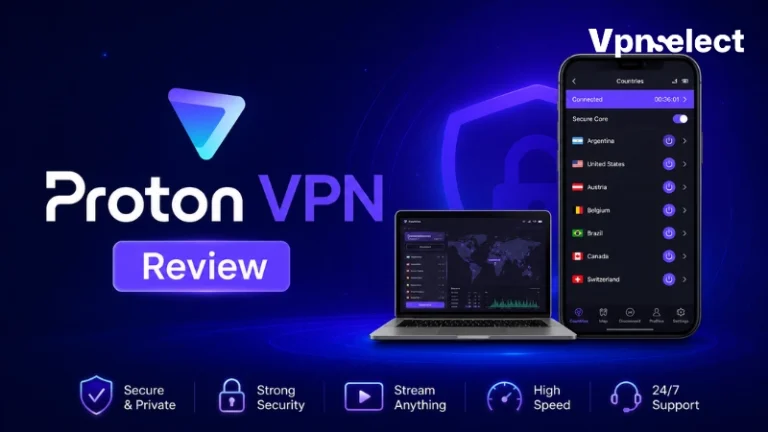
ProtonVPN combines Swiss jurisdiction with a fully open-source codebase audited annually by SEC Consult. Its Secure Core architecture routes traffic through privacy-hardened servers in Iceland, Sweden, or Switzerland before exiting – adding a physical infrastructure layer of protection. ProtonVPN’s free tier offers unlimited data with no logs, making it the only audited free option worth recommending. Paid plans unlock Tor-over-VPN, port forwarding, and access to 9,000+ servers across 112 countries.
ExpressVPN – Best for Ease of Use (20+ Audits, TrustedServer)
ExpressVPN holds the longest audit record of any provider reviewed here – over 20 independent security assessments since 2018, including annual reviews by KPMG and PricewaterhouseCoopers. Its TrustedServer technology ensures all servers run exclusively on RAM, with the OS reloaded from a read-only image on every boot. In 2017, Turkish authorities seized an ExpressVPN server and found no usable logs – a real-world validation of its policy. ExpressVPN operates under BVI jurisdiction and accepts Bitcoin.
Surfshark – Best Budget VPN with Unlimited Devices
Surfshark delivers audited no-logs performance at roughly half the price of NordVPN or ExpressVPN, with no device limit. Cure53 confirmed RAM-only operation across its 3,200+ server network in 2023. Surfshark accepts cryptocurrency, operates under Dutch jurisdiction, and includes a Nexus IP Rotator that changes your assigned IP periodically without dropping the connection – useful for long browsing sessions requiring consistent obfuscation.
IVPN – Best for Advanced Users (Warrant Canary, Privacy-First)
IVPN is purpose-built for users who treat privacy as non-negotiable. It maintains an active warrant canary updated quarterly, publishes its server infrastructure code publicly, and accepts Monero as its preferred payment method. IVPN requires no personal information at signup, supports native multihop routing across 2+ jurisdictions, and completed a full Cure53 audit in 2023. Its 77-server network across 32 countries is smaller than commercial competitors, but every node is under IVPN’s direct control – eliminating third-party data center exposure.
Private Internet Access – Best Court-Proven No-Log VPN
Private Internet Access has the most legally validated no-logs policy of any VPN in this list. In 2016 and again in 2018, the FBI subpoenaed PIA for user connection data – both times, PIA produced nothing because nothing existed. Its open-source clients, RAM-only servers, and anonymous cryptocurrency payment support are complemented by a MACE feature that blocks DNS-level ads and malware. PIA operates under US jurisdiction, but court-confirmed empty logs make jurisdiction less relevant when the data simply does not exist.
Anonymous VPN Comparison Table – Features Side by Side
The table below compares all 7 best anonymous VPNs across the criteria that matter most: audit status, server infrastructure, payment anonymity, jurisdiction, and court-tested outcomes. Use this breakdown to match each provider against your specific threat model before subscribing.
|
VPN |
No-Log Audits | RAM-Only | Anonymous Payment | Jurisdiction | Court-Tested |
|
NordVPN |
Deloitte, VerSprite | Yes | Crypto | Panama |
Yes |
|
Mullvad |
Cure53 | Yes | Cash, Monero | Sweden |
No |
|
ProtonVPN |
SEC Consult (annual) | Yes | Crypto | Switzerland |
No |
|
ExpressVPN |
KPMG, PwC (20+) | Yes | Bitcoin | BVI |
Yes (2017) |
|
Surfshark |
Cure53 | Yes | Crypto | Netherlands |
No |
|
IVPN |
Cure53 | Yes | Monero | Gibraltar |
No |
|
PIA |
Open-source audit | Yes | Crypto | USA |
Yes (2016, 2018) |
Which VPN Should You Choose? Best Pick by Use Case
Best for Torrenting
NordVPN and PIA both support P2P on dedicated server clusters with SOCKS5 proxy options. PIA’s port forwarding enables faster peer connections for seeding. Both have confirmed no-logs policies under legal pressure, which matters specifically for DMCA-heavy jurisdictions.
Best for Journalists and Activists
Mullvad and IVPN are the strongest choices for high risk users. Mullvad’s no-account model eliminates the identity link at subscription level. IVPN’s warrant canary and multihop routing add operational security layers. ProtonVPN’s Secure Core adds physical infrastructure separation for users facing nation-state adversaries.
Best for Censorship Bypass
ExpressVPN’s Lightway protocol and obfuscation technology have the strongest track record in China, Iran, and Russia. NordVPN’s obfuscated servers and Surfshark’s Camouflage Mode are reliable secondary options. Users in heavily restricted regions should also review best vpn for privacy criteria specific to censorship environments before choosing.
Best Free Tier
ProtonVPN is the only audited, truly unlimited free VPN. Its free plan includes no data cap, no speed throttling, and the same no-logs policy as paid tiers – verified by annual third-party audit.
Do No-Log Audits Actually Prove Anonymity?
No-log audits provide strong evidence of policy compliance at a specific point in time, but they do not prove permanent anonymity. An audit is a snapshot – it verifies that at the moment of review, the provider’s infrastructure was not storing user-identifiable connection data. It cannot guarantee the same configuration will remain in place after the audit window closes.
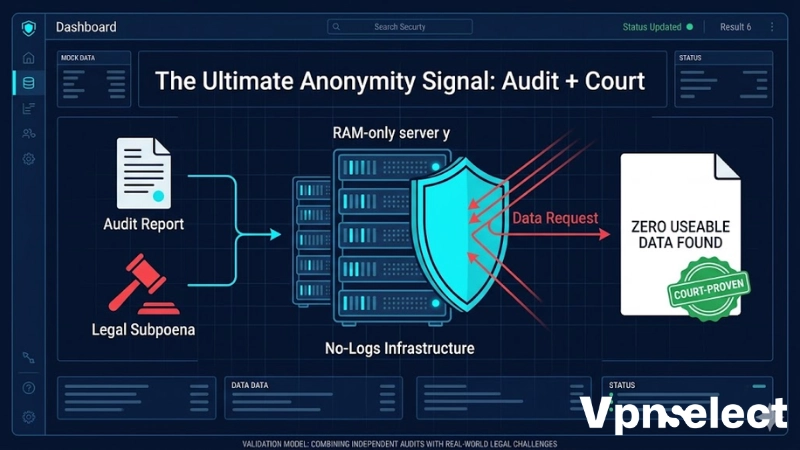
What audits do prove: the provider’s no-logs claims are technically implemented, not just written into a privacy policy. The most credible anonymity signal remains a combination of a clean audit plus a real legal challenge that returned no usable data – the combination NordVPN, ExpressVPN, and PIA all satisfy.
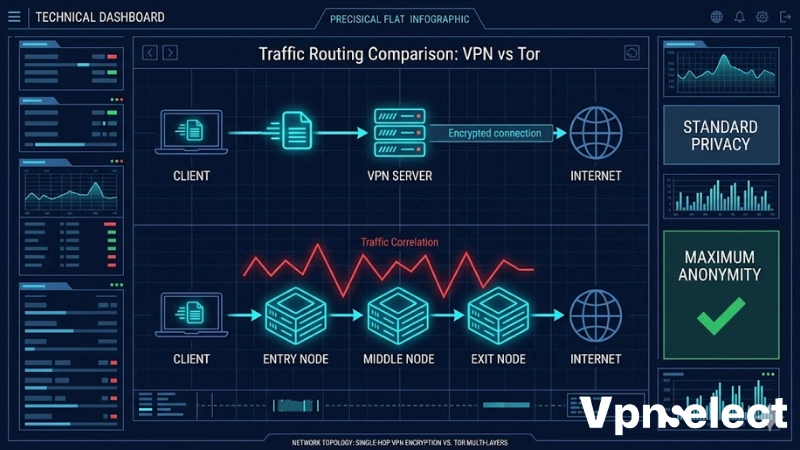
VPN vs. Tor – When a VPN Isn’t Enough
A VPN alone is insufficient when your adversary is a nation-state actor, when you need verifiable source protection as a journalist, or when you require true sender anonymity rather than just IP masking. Tor routes traffic through three independent relays globally, making traffic correlation attacks significantly harder than with a single VPN server.
The practical trade-off: Tor reduces speeds to 5-20 Mbps on average, blocks most streaming services, and is actively throttled in China, Russia, and Iran. For most users, a VPN with RAM-only servers and a verified no-logs policy provides sufficient protection. For the highest-risk users, Tor-over-VPN (available natively in ProtonVPN) provides a meaningful additional security layer. The full VPN Guide covers Tor-over-VPN configuration in detail.
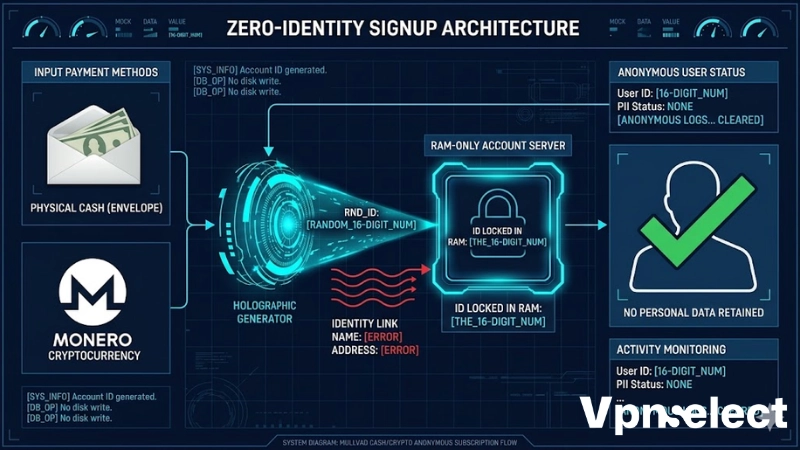
How to Sign Up for a VPN with No Email, No Name, No Trace
Specifically: Mullvad generates a random 16-digit account number at signup with no personal data requested. IVPN accepts the same flow. Pay with Monero rather than Bitcoin (Monero’s blockchain is untraceable; Bitcoin’s is not). Download the VPN client through Tor Browser to avoid linking your real IP to the download event. Complete the first connection before closing the Tor session.
FAQ
Is There a VPN That Is 100% Anonymous?
No VPN can guarantee 100% anonymity because the provider infrastructure, payment method, and signup process all create potential identity links. The closest available option is Mullvad, which eliminates account registration and accepts cash – but even Mullvad knows your real IP at the moment of first connection unless you route through Tor first.
Can Authorities Force a VPN to Share Your Data?
Authorities can issue legal orders requiring a VPN to produce user data. Whether that order yields anything usable depends entirely on whether the provider retains any data to hand over. PIA’s 2016 and 2018 FBI subpoenas, and ExpressVPN’s 2017 Turkish server seizure, both demonstrate that a genuinely implemented no-logs policy results in legally confirmed empty-handed outcomes – even under direct government pressure. For users evaluating risk in specific jurisdictions, best vpn for dark web use cases provide additional threat modeling context.
Leave a comment