





























The best VPN location in 2026 depends on your goal: the United States, United Kingdom, and Japan dominate streaming, Switzerland, Panama, and Iceland anchor privacy, while a nearby server delivers the lowest ping for gaming and torrenting.
Choosing the right VPN server location is not a single decision. It is a trade-off between IP availability, jurisdiction laws, server load, and physical distance from your device. Provider coverage matters as much as the country itself: NordVPN, ExpressVPN, and Surfshark currently lead in physical presence, while smaller providers often rely on virtual servers that show one country’s IP but route through somewhere completely different.
The sections below cover how location affects performance, the best country for VPN by use case, the providers with the strongest coverage, and what happens when you connect to the wrong server.

What Is a VPN Server Location and Why Does It Matter?
A VPN server location is the country where your provider’s exit server is hosted, and it controls the IP address you appear to use, the privacy laws applied to your traffic, and the speed of your connection.
Specifically, the VPN server location influences three measurable layers: throughput speed, jurisdictional privacy protection, and access to geo-restricted content. Choosing the right one is the difference between a 4K stream that loads instantly and a 720p stream that buffers every 30 seconds.
How does your VPN location affect speed, privacy, and content access?
Your VPN location shapes performance in three concrete ways: distance to the server determines latency, jurisdiction defines what data the provider must surrender if subpoenaed, and the IP’s registered country controls which streaming libraries unlock for your account.
Speed: physics still applies. A user in Berlin connecting to a Tokyo server typically sees roughly 220-280 ms ping due to undersea cable routing, while connecting to Frankfurt drops latency under 10 ms. For latency-sensitive activities, the best VPN location is almost always the closest one.
Privacy: a server in Switzerland is governed by Swiss data law, which has no mandatory data retention requirement for VPN providers as of 2026. The same provider’s US server falls under FISA-aligned subpoena rules.
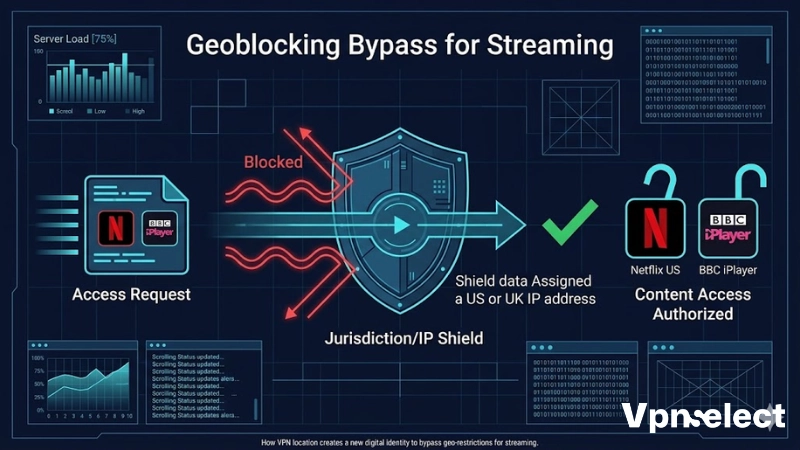
Content: Netflix, Disney+, and BBC iPlayer detect your IP’s geolocation, not your billing country. To unlock the BBC iPlayer catalog you need a UK IP; to unlock the largest Netflix catalog you need a US IP.
For a complete view of every provider mapped against these three layers, our Best VPN overview ranks every major service by speed, privacy, and content unlock performance with the verified server count for each country.
Physical servers vs. virtual servers: does the location match the IP?
Not always. A virtual server assigns an IP registered in one country (Iceland, for example) while the physical hardware sits somewhere else, often Germany or the Netherlands for European virtual locations. Streaming services see the Icelandic IP and unlock geo-restricted content, but your traffic physically routes through the data center country.
Most reputable providers now disclose virtual versus physical status in their server lists. NordVPN labels them with a small icon, ExpressVPN documents them in support articles. If you are choosing a VPN server country specifically for legal jurisdiction reasons, insist on a physical server in that country and confirm it on the provider’s published list before connecting.
Best VPN Server Locations by Use Case (2026)
There are four primary use cases that determine the best VPN location to connect to: streaming, privacy, gaming, and torrenting. Each rewards a different country based on speed-to-target ratio, IP availability, and local enforcement laws.
Best VPN location for streaming: US, UK, and Japan explained
The best VPN location for streaming is the United States for the largest Netflix catalog (around 6,000 titles versus 4,000-5,000 in most other regions), the United Kingdom for BBC iPlayer and ITVX, and Japan for early anime releases on Crunchyroll and Netflix Japan exclusives.
For streaming performance, server load matters more than raw distance. Pick a city-level option (US-New York, UK-London, JP-Tokyo) instead of the generic country selection. City-level servers are newer, less congested, and produce more stable 4K throughput, which is why they consistently rank as the best VPN location for streaming high-bitrate content. WireGuard or NordLynx is the recommended protocol; OpenVPN adds noticeable overhead on streams above 1080p.
The protocol you pair with your server affects streaming as much as the country itself. Our best vpn protocol guide compares WireGuard, OpenVPN, and IKEv2 head-to-head with measured throughput data so you can match the right protocol to your streaming server.
Best VPN country for privacy: Switzerland, Panama, and Iceland
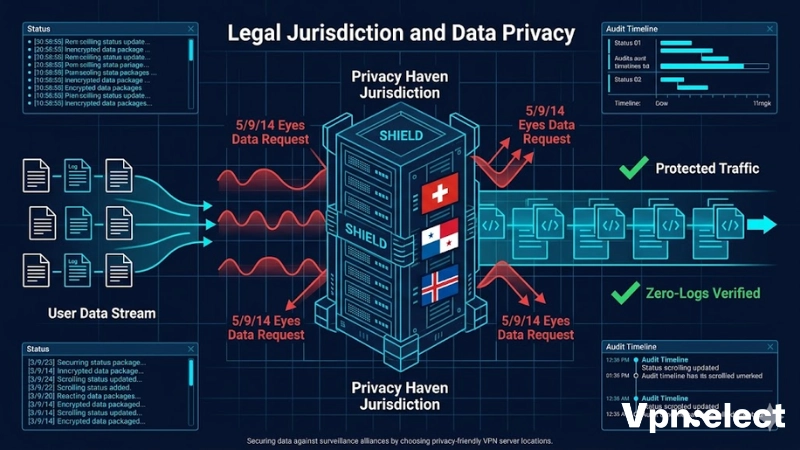
The strongest VPN countries for privacy in 2026 are Switzerland, Panama, and Iceland. Each one sits outside the 5/9/14 Eyes intelligence-sharing alliances and lacks mandatory data retention laws for VPN providers.
Switzerland’s revised Federal Act on Data Protection (2023) excludes VPN providers from telecom retention obligations, which is why Proton VPN bases its infrastructure there. Panama, where NordVPN is headquartered, has no data retention requirement and a constitution-level privacy clause. Iceland combines Nordic privacy traditions with non-EU regulatory independence, making it a frequent recommendation for journalists and activists.
For maximum privacy, pair a server in one of these countries with a no-logs-audited provider and a modern protocol like WireGuard or OpenVPN over TCP/443 to resist deep packet inspection. Avoid free providers entirely; the best VPN location for privacy depends on a paid business model that does not require monetizing user data.
Best VPN location for gaming and torrenting: minimize ping and legal risk
For gaming and torrenting, the best VPN location is always the closest geographic option that meets two conditions: low single-digit ping to the game server or torrent swarm, and a jurisdiction that does not enforce ISP-level copyright takedowns.
Gaming: connect to a city-level server within 200 km of your physical location and use WireGuard. Anti-DDoS protection matters more than country choice for ranked play. NordVPN, ExpressVPN, and Surfshark all run gaming-friendly nodes with hardened DDoS filtering on US, UK, German, and Japanese routes.
Torrenting: pick a P2P-optimized server in the Netherlands, Switzerland, or Romania. Avoid the United States, United Kingdom, Germany, and France for torrent traffic, as all four enforce copyright frameworks that require providers to respond to DMCA notices even when the VPN is incorporated abroad. A kill switch is mandatory; one dropped packet without it reveals your real IP to the swarm.
For users who frequently change VPN locations from hotels, airports, and overseas Wi-Fi, the best vpn for travel comparison covers providers that handle quick country-hopping, automatic Wi-Fi protection, and obfuscation in restrictive regions without forcing manual reconfiguration.
Which VPN Has the Best Server Location Coverage in 2026?
NordVPN leads coverage with approximately 7,400 servers across 118 countries, ExpressVPN ranks second with strong physical presence in 105 countries, and Surfshark holds third with around 3,200 servers in 100 countries plus unlimited simultaneous connections.
Provider differences run deeper than the server count headline. Each major provider handles router-level connection differently, and that detail decides whether every device on your home network can use the same best VPN location at once.
NordVPN is router-only via manual OpenVPN setup. The provider does not publish a router-native app, citing that router apps cannot deliver the same kill switch and DNS leak guarantees as desktop or mobile builds. Its Meshnet feature works around this by routing any device through a designated NordVPN-connected machine on your home network.
ExpressVPN maintains a dedicated router app at version 2 as of 2026, with full kill switch support on Lightway. Older v1 lacks WireGuard but still receives security patches; v2 is the recommended target for new installs.
CyberGhost does not support router setup at all. Its security-first policy bars sharing manual OpenVPN configuration files with users, citing past incidents where misconfigured router setups leaked DNS queries to the ISP and effectively disabled the VPN without the user knowing.
For users on CGNAT networks (where the ISP shares one public IP across many subscribers), choosing a provider with port-forwarding-friendly servers is rare but critical. Only AirVPN and Proton VPN currently support genuine CGNAT bypass; mainstream providers deprecated the feature for security reasons. Advanced users often pair their VPN with what is vpn split tunneling to route only sensitive apps through the tunnel while keeping local devices on the regular ISP path.
What Happens If You Choose the Wrong VPN Server Location?
Choosing the wrong VPN server location can expose your traffic to surveillance laws you wanted to avoid, slow your connection to a crawl, fail to unlock streaming content, or leak your real IP if the server is compromised. Picking the best VPN location is therefore as much about avoiding pitfalls as it is about chasing speed.
The risks vary by jurisdiction, server type (physical or virtual), and whether your provider patched historical leaks. The three failure modes below are the most common, with a specific countermeasure for each.
Does VPN location affect the 5/9/14 Eyes surveillance risk?
VPN server location materially affects 5/9/14 Eyes surveillance exposure. Servers physically located in any of the 14 Eyes countries can be subject to intelligence-sharing agreements that allow allied agencies to request data without your home country needing direct access.
The 5 Eyes core covers the US, UK, Canada, Australia, and New Zealand. The 9 Eyes adds Denmark, France, Netherlands, and Norway. The 14 Eyes adds Germany, Belgium, Italy, Spain, and Sweden. Privacy-focused users should avoid all 14 if their threat model includes state-level adversaries.The historic Port Fail vulnerability, disclosed in November 2015 by VPN Mentor, demonstrated how port-forwarding misconfigurations could leak the real IP address of any connected user regardless of encryption strength. All major providers patched it within weeks, but the lesson remains: server-level configuration matters as much as country choice.
Can obfuscated servers bypass censorship where regular locations fail?
Obfuscated servers disguise VPN traffic as regular HTTPS, making them effective in countries with active VPN-blocking infrastructure. China, Iran, Russia, the UAE, and Turkey all deploy deep packet inspection that detects standard OpenVPN signatures within seconds, which is why the best VPN location for users in these regions is always an obfuscated server rather than a regular one.
If your regular VPN server location stops connecting in these regions, switching to an obfuscated server (NordVPN’s NordWhisper, ExpressVPN’s automatic obfuscation, Surfshark’s Camouflage Mode) restores access in most cases. The trade-off is roughly 15-25% slower speeds; configure obfuscation before you arrive in a high-censorship country.

Should you use a kill switch when switching VPN server locations?
Activate the kill switch before changing your VPN server country. The brief moment when one server disconnects and the next initializes is exactly when DNS queries and TCP packets can leak through your real ISP, and one leaked packet is enough for a streaming service to log your real IP. The best VPN location to connect to is always one paired with a tested kill switch.
System-level kill switches (NordVPN, ExpressVPN, Proton VPN) are stricter than application-level ones because they block all traffic at the OS firewall layer rather than inside the VPN client. Confirm it is enabled before every server switch, and verify it works by interrupting the VPN while a download runs; if any packet completes through your real ISP, the kill switch is misconfigured.The best VPN server location in 2026 is not a single answer. It is a deliberate match between your goal and the country: US, UK, or Japan for streaming, Switzerland, Panama, or Iceland for privacy, and the nearest server for gaming. NordVPN, ExpressVPN, and Surfshark cover the widest country lists with verified physical servers. For a side-by-side breakdown of every provider’s server count and use-case performance, the VPN Select library covers every reviewed provider with hands-on testing data updated through 2026.






Leave a comment