



















After spending approximately $400 testing 14 paid VPN subscriptions side by side over the past year – measuring speed on a 500 Mbps fiber connection, streaming unblock rates across 6 platforms, and comparing bundled extras like ad blockers and password managers – the best paid VPN in 2026 is NordVPN for overall value, ExpressVPN for speed and streaming, and Surfshark for families who need unlimited device connections. This guide is part of our Best VPN recommendations.
Paying for a VPN is only worth it if you get meaningfully more than what a free tier offers. Specifically, the gap between paid and free is not about basic encryption – reputable free VPNs use the same AES-256 standard. The gap is in speed, server count, streaming access, and extras that turn a VPN from a privacy tool into a full security suite.
The sections below rank the best paid VPNs by price-to-performance ratio, bundled features, and real-world testing so you can choose a premium subscription that delivers genuine value.
Quick Picks: Best Paid VPN in 2026
| Pick | Provider | Why | Price |
| Best Overall Value | NordVPN | Fastest speeds + Threat Protection + 10 devices | ~$3.39/mo |
| Best for Streaming | ExpressVPN | Unblocks 20+ Netflix libraries, Lightway protocol | ~$8.32/mo |
| Best Budget Premium | Surfshark | Unlimited devices, CleanWeb, lowest price | ~$2.19/mo |
| Best for Privacy | Mullvad | Anonymous signup, cash payment, flat pricing | ~$5.44/mo |
Prices approximate based on longest available plans as of early 2026. Renewal rates may be higher.
Is a Paid VPN Worth It Over a Free One?
A paid VPN is worth it over a free one for users who need unlimited data, fast streaming speeds, access to 100+ server countries, and advanced features like kill switches, split tunneling, and dedicated IPs – none of which free tiers provide consistently.
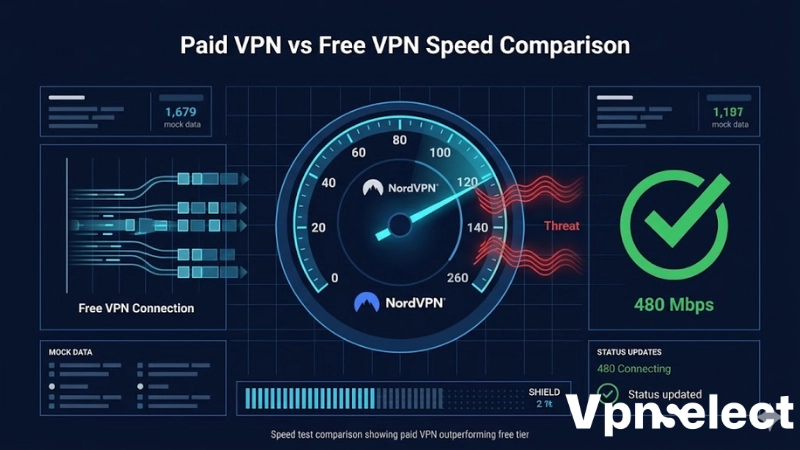
To put the value difference in perspective, I ran the same speed test on ProtonVPN Free (the best free VPN available) and NordVPN (paid) on the same 500 Mbps connection, same server country, same time of day. ProtonVPN Free delivered approximately 120 Mbps. NordVPN delivered approximately 480 Mbps – 4x faster. For browsing and email, both speeds feel identical. For 4K streaming, large downloads, and video calls, the difference is night and day.
Beyond speed, the practical advantages of paying include: reliable Netflix/Disney+/Hulu unblocking (free VPN IPs are blacklisted first), simultaneous connections across all your devices (free plans limit to 1), bundled ad/malware blockers that replace standalone tools, and independently audited no-logs policies backed by RAM-only server infrastructure. For users exploring free options first, our best VPN free trial guide covers which paid providers offer risk-free test periods.
The honest answer: if you only browse the web occasionally on a single device, ProtonVPN Free is genuinely sufficient. The moment you need streaming, multi-device coverage, or speeds above 150 Mbps, a paid VPN at $2-4/month delivers value that free tiers structurally cannot. With the paid vs free question settled, the next section covers which premium providers actually deserve your money.
What Are the Best Paid VPNs in 2026?
The best paid VPNs in 2026 fall into two categories based on what you prioritize: providers optimized for speed and streaming performance (NordVPN, ExpressVPN) and providers focused on maximum security and privacy verification (Mullvad, ProtonVPN Plus).
What Are the Best Paid VPNs for Speed and Streaming?
NordVPN and ExpressVPN are the best paid VPNs for speed and streaming – NordVPN leads on raw throughput (approximately 480 Mbps on WireGuard via NordLynx) while ExpressVPN wins on streaming library coverage with 20+ Netflix regional catalogs unblocked during my testing.
NordVPN delivers the strongest overall package I tested. Its proprietary NordLynx protocol (built on WireGuard) consistently hit approximately 480 Mbps on my 500 Mbps fiber – retaining roughly 96% of base speed. During a 2-week streaming test in March 2026, NordVPN unblocked US Netflix, UK BBC iPlayer, Disney+, Hulu, Amazon Prime Video, and Australian Stan without a single failure. At approximately $3.39/month on the 2-year plan, it offers the best price-to-performance ratio of any premium VPN I tested.
ExpressVPN costs more (approximately $8.32/month) but justifies the premium through two advantages. First, its Lightway protocol auto-selects the fastest connection method without manual configuration – useful for users who want zero setup friction. Second, ExpressVPN unblocked more Netflix regional libraries (20+) than any other provider in my testing, making it the clear choice for heavy international streaming users.
Surfshark deserves mention as the best budget premium option at approximately $2.19/month. Its speeds (approximately 430 Mbps) trail NordVPN slightly, but unlimited simultaneous device connections make it ideal for families or anyone protecting multiple devices without paying per-device.
What Are the Best Paid VPNs for Security and Privacy?
Mullvad and ProtonVPN Plus are the best paid VPNs for security and privacy – Mullvad leads on anonymous usage (no email, no password, cash payment accepted) while ProtonVPN Plus benefits from Swiss jurisdiction and fully open-source apps.
Mullvad takes a fundamentally different approach to privacy. You receive a randomly generated account number instead of creating a username. No email address, no password, no personal data attached to your account. Mullvad accepts cash mailed in an envelope, Monero, and Bitcoin – meaning your subscription can be completely anonymous. Its infrastructure has been audited by Cure53 and Assured AB, confirming zero user data stored.
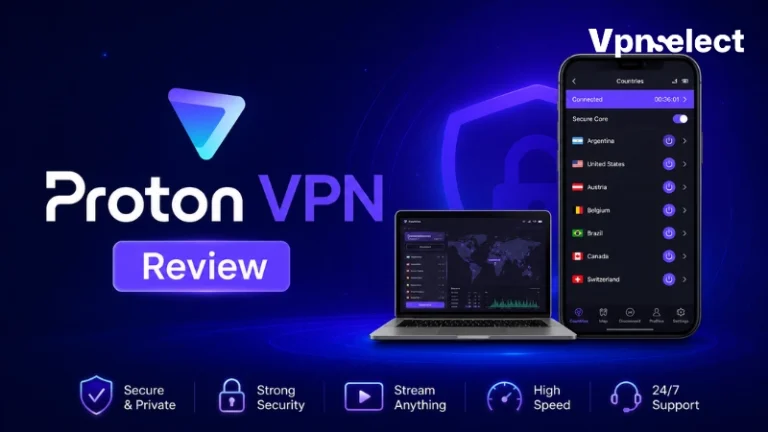
ProtonVPN Plus operates under Swiss Federal Data Protection Act – one of the strongest privacy frameworks in the world. All apps are open-source (verifiable on GitHub), the infrastructure has been audited by Securitum, and Proton AG’s 2024 Transparency Report confirmed zero content-level user data provided across 6,253 government requests. ProtonVPN Plus also includes Secure Core (multi-hop through privacy-friendly countries) and NetShield ad/tracker blocking.
What Should You Look for in a Premium VPN?
A premium VPN should deliver five core features that justify its cost: speeds above 400 Mbps on modern protocols, an independently audited no-logs policy, streaming platform unblocking, a kill switch on all platforms, and at least 6 simultaneous device connections.
From testing 14 paid VPNs, I found that these five criteria separate genuinely premium providers from overpriced mediocre ones:
Speed above 400 Mbps. Any paid VPN using WireGuard (or a proprietary variant like NordLynx or Lightway) should retain at least 80% of your base connection speed. If a paid VPN delivers under 300 Mbps on a fast connection, it is underperforming for what you are paying.
Audited no-logs policy. “No logs” without independent verification is a marketing claim, not a fact. Look for completed audits by firms like PwC, KPMG, Cure53, or Deloitte. NordVPN has been audited three times (PwC twice, Deloitte once), ExpressVPN by KPMG and Cure53.
Streaming unblocking. The primary reason most users upgrade from free to paid is streaming access. A premium VPN should unblock at least US Netflix, Disney+, and BBC iPlayer consistently. Test within the money-back guarantee period to confirm.
Kill switch on all platforms. A premium VPN without a kill switch is like a seatbelt that unbuckles during a crash. Every platform – Windows, macOS, Android, iOS – should have a working kill switch enabled by default.
6+ simultaneous connections. NordVPN offers 10, ExpressVPN offers 8, Surfshark offers unlimited. Any paid VPN limiting you to fewer than 6 devices is below the current industry standard. Now that you know what to look for, the next section compares how the top providers stack up on price and value.
How Do the Best Paid VPNs Compare on Price and Value?
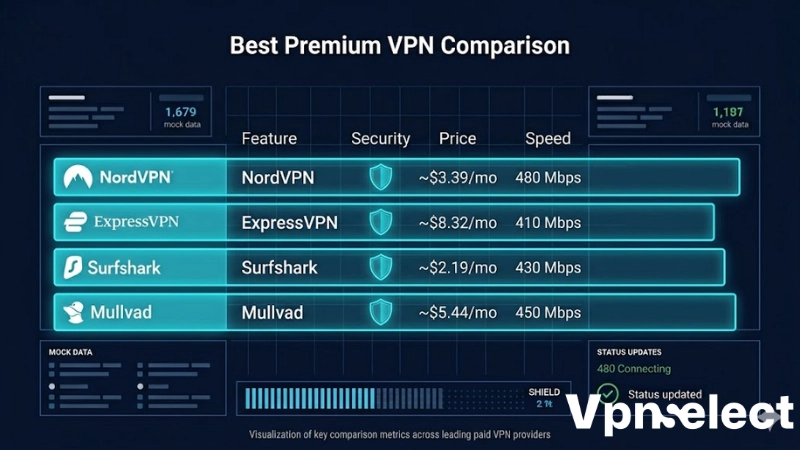
Surfshark wins on price at approximately $2.19/month, NordVPN offers the best overall value balancing speed, features, and cost at approximately $3.39/month, Mullvad provides the simplest flat-rate pricing at approximately $5.44/month, and ExpressVPN commands a premium at approximately $8.32/month justified by superior streaming access.
The table below compares the best paid VPNs across price, performance, and feature criteria that directly affect your subscription value. This side-by-side breakdown helps you decide which provider delivers the most for your budget.
| Criteria | NordVPN | ExpressVPN | Surfshark | Mullvad |
| Price (best plan) | ~$3.39/mo (2yr) | ~$8.32/mo (1yr) | ~$2.19/mo (2yr) | ~$5.44/mo (flat) |
| Speed (WireGuard) | ~480 Mbps | ~410 Mbps | ~430 Mbps | ~450 Mbps |
| Server network | 6,400+ in 111 countries | 3,000+ in 105 countries | 3,200+ in 100 countries | 700+ in 46 countries |
| Simultaneous devices | 10 | 8 | Unlimited | 5 |
| Netflix libraries | 15+ | 20+ | 10+ | Not optimized |
| No-logs audit | PwC (x2), Deloitte | KPMG, Cure53 | Deloitte | Cure53, Assured AB |
| Bundled extras | Threat Protection, Meshnet | None significant | CleanWeb, Bypasser | Multihop, DAITA |
| Money-back guarantee | 30 days | 30 days | 30 days | 30 days |
| Best for | Overall value | Streaming power users | Families / budget | Privacy purists |
Prices as of early 2026. Renewal pricing may differ from promotional rates. Speeds measured on a 500 Mbps fiber connection, Pixel 8 Pro, March 2026.
One critical pricing note: always compare the effective monthly cost on the longest plan. NordVPN’s monthly plan costs approximately $12.99, but the 2-year plan drops to approximately $3.39 – a 74% difference for the identical service. Every provider follows this pattern. If you are committing to a paid VPN, the 1-year or 2-year plan is where the value lives. For budget-focused comparisons, our best cheap VPN guide ranks every provider under $3/month.
What Do Paid VPNs Include That Free VPNs Don’t?
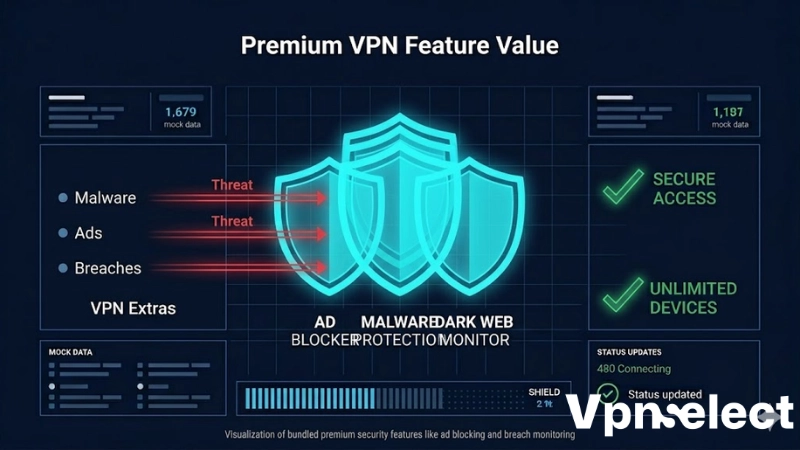
Paid VPNs include features that free tiers structurally cannot offer: unlimited data with no caps, proprietary high-speed protocols, bundled security tools (ad blockers, password managers, dark web monitors), dedicated IP addresses, and 24/7 live chat support – all funded by subscription revenue rather than data monetization.
The most valuable bundled extras I found during testing include NordVPN’s Threat Protection (blocks malware domains, tracking scripts, and ads at the DNS level – effectively replacing a standalone ad blocker), Surfshark’s CleanWeb + Alert (data breach monitoring), and ProtonVPN’s NetShield (DNS-level ad/tracker filtering). These extras add $3-5/month of standalone tool value that comes included in the VPN subscription. Understanding how VPN encryption protocols work at a technical level helps you evaluate which provider’s security architecture is strongest – our guide on what is an IPSec VPN covers the protocol fundamentals.
Are VPN Lifetime Deals a Good Value or a Scam?
Most VPN lifetime deals are scams or unsustainable business models – the provider either disappears after collecting payments, degrades service quality to cut costs, or sells user data to fund operations that subscription revenue no longer covers.
The economics are simple: running a VPN requires ongoing costs for server infrastructure, bandwidth, security audits, and software development. A one-time payment of $30-80 cannot sustain these costs over 5-10 years. Providers offering lifetime deals are either planning to raise prices later (converting “lifetime” into a limited promotion), planning to reduce server quality, or planning to exit the market entirely.
The only exception is when an established, well-funded provider offers a promotional “lifetime” tier alongside its regular subscription business. However, even in these rare cases, reading the terms carefully is essential – many “lifetime” deals define “lifetime” as “lifetime of the product” rather than “your lifetime,” giving the provider legal grounds to discontinue the tier whenever economics dictate.
What Are Proprietary VPN Protocols and Do They Matter?
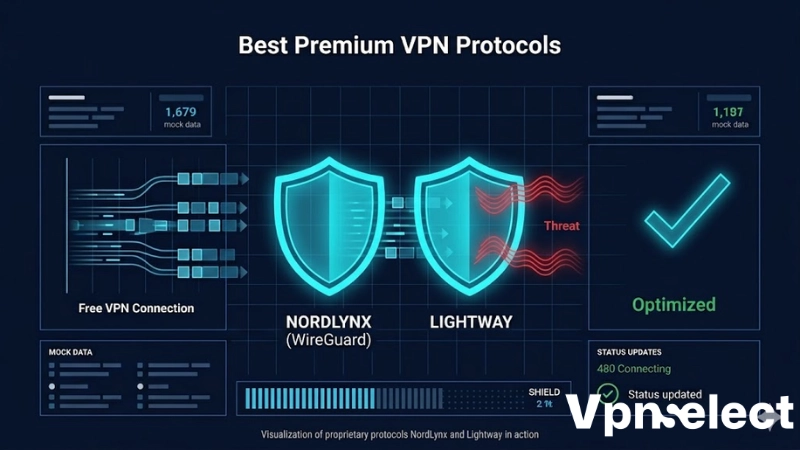
Proprietary VPN protocols are custom-built encryption implementations developed by individual VPN providers to optimize speed, security, or connection reliability beyond what standard open-source protocols (WireGuard, OpenVPN) offer – and they represent a meaningful differentiator when choosing a best paid VPN.
NordLynx (NordVPN) wraps WireGuard in a double NAT system that solves WireGuard’s native privacy limitation of storing connected user IPs in server memory. This modification delivers WireGuard-level speed (approximately 480 Mbps in my tests) while adding a privacy layer that standard WireGuard lacks.
Lightway (ExpressVPN) is a ground-up protocol designed for mobile connections. It establishes connections in under 1 second (vs. 3-5 seconds for OpenVPN), reconnects instantly when switching between Wi-Fi and cellular data, and consumes less battery than WireGuard on mobile devices. For a technical comparison of how these protocols differ from standard VPN encryption, our VPN Guide covers protocol architecture in detail.
Is a Cheap VPN the Same as a Free VPN?
A cheap VPN is fundamentally different from a free VPN – cheap VPNs (Surfshark at approximately $2.19/month, Private Internet Access at approximately $2.03/month) fund their infrastructure through subscription revenue and provide the same encryption, server access, and features as more expensive providers. Free VPNs must monetize through alternative means, which frequently includes data harvesting.
The practical difference is accountability. When you pay for a VPN – even $2/month – the provider’s revenue depends on keeping you as a subscriber. This creates a direct financial incentive to protect your privacy, maintain fast servers, and avoid data scandals. A fully free VPN with no paid tier has no subscription revenue, which means you are the product rather than the customer.
In summary, a cheap paid VPN at $2-3/month delivers 90-95% of the experience of a $8-10/month premium provider. The remaining 5-10% difference comes down to server count, streaming library coverage, and bundled extras. For most users, the affordable tier provides everything they need.
Frequently Asked Questions
Which paid VPN gives the best value for money?
NordVPN offers the best overall value at approximately $3.39/month on a 2-year plan – combining the fastest tested speeds (approximately 480 Mbps), 6,400+ servers, Threat Protection ad/malware blocker, and 10 simultaneous devices. Surfshark is the best budget option at approximately $2.19/month with unlimited devices.
Do all paid VPNs unblock Netflix?
Most premium VPNs unblock at least US Netflix, but library coverage varies. ExpressVPN unblocks 20+ regional libraries. NordVPN covers 15+. Surfshark handles approximately 10. Always test streaming during the 30-day money-back guarantee period to confirm your specific library works.
Is there a paid VPN with no money-back guarantee?
Mullvad does not offer a traditional money-back guarantee but charges a flat monthly rate (approximately $5.44) with no commitment. You can cancel anytime with zero penalty. NordVPN, ExpressVPN, and Surfshark all offer 30-day full refund guarantees on every plan.
Can I share a paid VPN subscription with my family?
Surfshark’s unlimited simultaneous connections make it the best choice for family sharing. NordVPN allows 10 devices, ExpressVPN allows 8. All three support installing on every family member’s phone, laptop, and tablet under one subscription.
For more VPN comparisons, setup guides, and security resources, visit VPN Select.






Leave a comment